

Design Tetris Game
Design a Tetris Game that supports real-time block movement, collision detection, line clearing, and score tracking on a fixed-size grid.
Tetris is a classic tile-matching puzzle game where players control falling shapes, called tetrominoes, and arrange them on a fixed-size vertical grid. The objective is to form complete horizontal lines without gaps.
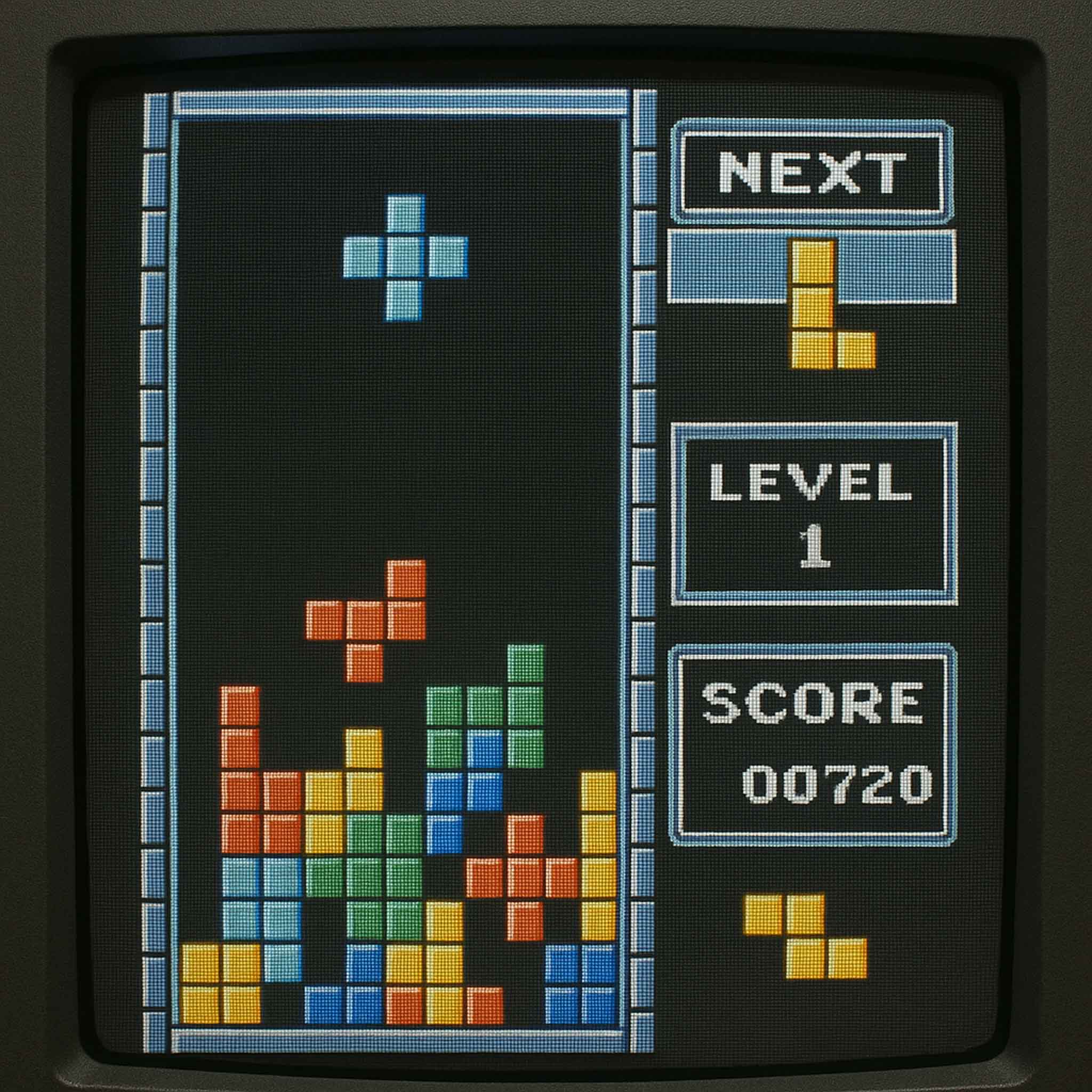
Key game mechanics include:
- Tetrominoes falling at a constant or increasing speed
- Player-controlled movement (left, right, down) and rotation
- Collision detection to prevent overlapping or going out of bounds
- Clearing full lines, which increases the player’s score and creates more space
- Ending the game when new blocks can no longer be placed
In this chapter, we will explore the low-level design of Tetris game in detail.
Let's start by clarifying the requirements:
1. Clarifying Requirements
Before starting the design, it's important to ask thoughtful questions to uncover hidden assumptions, clarify ambiguities, and define the system's scope more precisely.
Here is an example of how a conversation between the candidate and the interviewer might unfold:
Candidate: Should we stick to the standard 10x20 board size for the Tetris grid?
Interviewer: Yes, for this version, let’s stick to the standard 10 columns and 20 rows.
Candidate: How many types of tetrominoes should the game support? Should we include all 7 standard Tetris shapes?
Interviewer: Yes, the game should support all 7 standard tetrominoes: I, O, T, S, Z, J, and L.
Candidate: Should we support features like piece rotation and soft/hard drop?
Interviewer: Yes, both rotation and movement (left/right/down) should be supported. Hard drop is optional but nice to have.
Candidate: Should the game speed up over time as the player scores more or clears lines?
Interviewer: Yes, the speed should gradually increase after a certain number of lines are cleared or after reaching higher levels.
Candidate: What should happen when a full row is completed? Should it be cleared immediately?
Interviewer: Yes, any fully filled row should be removed immediately, and all rows above it should shift downward.
Candidate: Do we need to track and display the player's score and level progression?
Interviewer: Yes, the game should display the current score and level, and update them as the player progresses.
Candidate: Should we take input from user or predefine a set of moves?
Interviewer: Predefine
After gathering the details, we can summarize the key system requirements.
1.1 Functional Requirements
- The game is played on a 10x20 grid
- Support all 7 standard Tetris tetrominoes (I, O, T, S, Z, J, L)
- Allow tetromino movement: left, right, and down (soft drop)
- Allow rotation of tetrominoes (clockwise; counterclockwise is optional)
- Automatically drop pieces at a fixed interval, which decreases with level progression
- Clear any fully filled row and shift the rows above downward
- Track and display player score and level
- End the game when new tetrominoes cannot be placed due to filled cells
1.2 Non-Functional Requirements
- Modularity: The game should be composed of well-separated components
- Extensibility: The design should be extensible to support future features
- Maintainability: The codebase should follow object-oriented principles and be easy to test, extend, and debug
- User Feedback: The game should display real-time score, level, next piece preview, and game over messages clearly in the console